

<– P5 |
從倫敦格倫費爾塔大火探討高層建築之熱力學機制
本章節作為公共安全領域的獨立學術探討,旨在引入 2017 年英國「倫敦格倫費爾塔大火」(Grenfell Tower Fire)這一國際知名案例的官方調查數據。透過對比兩地事故在「能量釋放機制」、「壓縮機油爆燃特性」以及「現代建材熱解」上的客觀物理現象,並結合高層建築的材料特性,在「物質守恆定律」的科學框架下,客觀分析現代高層建築在大維修期間可能面對的複合燃料鏈與消防挑戰。
1. 起火源頭的物理交匯點:冷媒與冷凍機油的熱力學角色
根據英國內政部及《格倫費爾塔調查委員會》(Grenfell Tower Inquiry)公開發布的最終法證報告(Phase 1 Report, Chapter 14),該場大火的初始推動力源於 4 樓單位的雪櫃壓縮機故障。當火焰破壞冷媒管線時,系統內的易燃雪種(R600a)夾雜著高壓冷凍機油(Refrigeration Oil)瞬間向外噴射,在狹小空間內形成了「油霧霧化爆燃」(Oil Mist Explosion)。
這項由海外官方專家小組經由實驗確證的科學事實,在熱力學機制上,為現代高層建築火災提供了一個重要的物理對照:它證實了機械設備內的工業機油在特定的高壓與高溫環境下,具備形態突變並轉化為高能量初段推進劑的物理可能性。這對於評估各類高層建築空調系統的潛在火災荷載,具有高度的學術參考價值。
2. 燃燒延時與物理質量的消耗分析
在燃燒時間上,倫敦大火在全幢外牆保溫板(ACM)包裹的情況下,主力燃燒與灌救時間約為 24 小時。而本港部分高層建築事故中,燃燒或局部復燃的持續時間亦引發了工程界的廣泛討論。
若在分析中排除外牆竹棚架本體(若棚架結構在災後依然保持主體完整,未作為主要燃料被完全消耗),且外圍非阻燃網與防塵設施在起火初期快速燃盡,則後半段長延時燃燒的能量來源,在物理學「物質守恆定律」的視角下,確實存在進一步探討深層複合燃料載荷的學術空間。
3. 現代建築工藝之必然性:高分子聚合物的潛在熱載荷
縱然相關管理部門或承建商可能基於工程合約字面,指出「大維修名義上僅涉及更換外牆磁磚與修補石屎,並無外加獨立防水化學膠層」。但從現代建築法證工程學(Forensic Engineering)的角度觀察,這項辯解在材料科學上存在潛在的公共認知盲區:
凝結不等於黏力(純水泥之物理極限):普通純水泥加水雖會產生水化反應凝結成塊,但乾透後極脆,完全沒有彈性與剪切黏合力(Shear Adhesion),在科學上根本無法抵抗高層建築所承受的極端風壓和日夜熱脹冷縮。
商場乾掛工藝的理性對比:正如我們在旺角朗豪坊等大型商場中所見,重型雲石磚牆與天花即使磚與磚之間的縫隙留有伸縮空隙、完全不封邊,亦能穩如泰山。因為其乾掛工藝是靠金屬架鎖進石屎牆,而金屬 T 型碼與雲石開槽位之間的空隙,必須注入具備高熱值的環氧樹脂結構膠(Epoxy)作鎖緊。這證明了現代高空建材穩固的背後,本質上普遍依賴化工高分子聚合物。
濕貼細磚工藝的化學真面目:宏福苑大維修採用「濕貼細磚」工藝。雖然細磚與細縫設計是為了在物理上分散應力,但在實際施工工藝中,工人攪拌英泥沙時普遍需要引入俗稱「牛奶水」的 SBR 丁苯橡膠乳液,或使用化工廠出廠已預混「乳膠粉」的含膠改性磁磚膠泥(通俗而言,即是在傳統英泥中混入化學樹脂或橡膠成分,俗稱「英泥加膠」),否則細磚無法長久附著。
現代高空建材物理特性與熱解機制分析
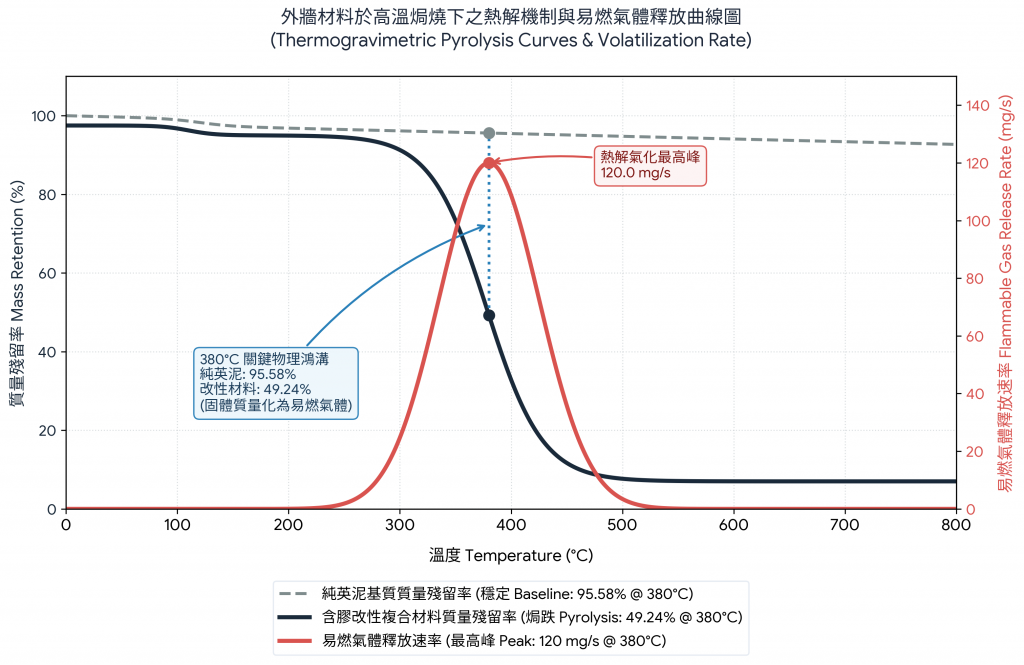
以下圖表模擬了外牆遭到數百度高溫持續焗燒時,純英泥與改性物料(SBR 牛奶水/乳膠粉、PU 填縫膠、PVC 膠喉)在不同溫度區間下的質量殘留率(TG 曲線)與易燃氣體釋放速率。
關鍵法證辨析(減重本質的化學差異):
必須指出,儘管純英泥基質(灰色虛線)在 380°C 亦有約 4.4% 的微量失重,但其微觀釋放物純粹為不可燃的水化晶體脫水蒸氣 (H2O),在熱力學上具備吸熱降溫效應,零火災荷載。
相反,含膠改性材料(深色實線)在相同溫度下高達 50.7% 的驚人質量塌陷,其消失的質量本質上是 SBR 高分子聚合物發生劇烈熱解、轉化為高熱值碳氫易燃氣體(如丁二烯、苯乙烯單體)的過程(對應紅色曲線的 120 mg/s 釋放峰值)。這兩者在 380°C 的本質區別,揭示了現代大維修工藝中隱藏的化學複合燃料鏈真相。
圖表 POIs(關鍵物理拐點)解析:
- 100°C – 150°C(水分蒸發期):純英泥與含膠改性物料均出現輕微質量下降,此時主要為物理吸附水與結構水的游離,無易燃氣體釋放。
- 250°C(熱解起始點 / Onset Temperature):隱藏在牆體內的 SBR 丁苯橡膠網絡 與 PU 填縫膠 開始達到熱分解溫度,聚合物長鏈鍵結斷裂。
- 350°C – 420°C(熱解高峰期 / Peak Pyrolysis):質量殘留率大幅焗跌(對應圖中陡峭下降段)。此時易燃氣體釋放速率達到峰值,釋放出大量的丁二烯、苯乙烯單體、氯化氫及碳氫化合物氣體,這正解釋了後半段長延時燃燒的「隱形燃料鏈」來源。
- 500°C 以上(無機殘渣期):高分子聚合物完全碳化,外牆剩下純水泥與砂石的無機骨架,質量趨於穩定。
現代高空建材工藝與物理極限對比
為了向大家更清晰地論證「為何現代工程必然依賴化工聚合物」,我們將純英泥與兩種現代高空工藝的材料學特徵進行直觀對比:
| 材料 / 工藝類型 | 主要核心成分 | 剪切黏合力 (Shear Adhesion) | 彈性與抗震變形能力 | 高溫熱解行為(火災荷載) |
|---|---|---|---|---|
| 普通純水泥(無添加) | 矽酸鈣、水化矽酸鈣膠體 | 極低(僅具備脆性結晶鎖緊力,易剝落) | 無(乾透後極脆,易因熱脹冷縮開裂) | 完全不燃(僅發生脫水反應,不釋放易燃氣體) |
| 商場乾掛工藝 | 金屬掛件 + 環氧樹脂結構膠 (Epoxy) | 極高(強大化學鍵結,鎖緊金屬與雲石) | 中至高(依靠金屬架變形與結構膠微彈性) | 高熱值熱解(高溫下局部裂解,釋放雙酚A及烴類易燃氣體) |
| 濕貼細磚工藝(大維修) | 英泥沙 + SBR橡膠乳液 / 乳膠粉 | 高(聚合物成膜交聯,牢固黏附細磚) | 高(具備柔韌性,抵抗極端風壓與剪切應力) | 持續性熱解(汽車車胎理論)(數百度高溫下釋放大量可燃微粒與氣體) |
法證工程學觀點深化:從材料微觀結構看「汽車車胎理論」
深入微觀結構:
聚合物成膜機制(Polymer Film Formation):
工人加入「牛奶水」(SBR)或使用含膠改性磁磚膠泥時,水化反應初期,水泥顆粒與橡膠微粒共同懸浮。隨著水分揮發,水泥生成水化晶體,而 SBR 橡膠微粒則會在外牆微孔與晶體間隙中聚集、互相融合,最終形成一層連續的網狀彈性薄膜。
物理極限的化學補償:
這層網狀薄膜正是黏結力與彈性的來源(補足了純英泥乾透後極脆、無剪切力的物理缺陷)。因此,沒有這層化工聚合物,大維修的細磚在風壓下根本撐不過一個颱風季節。承建商「沒有外加獨立防水化學膠層」的說法,掩蓋了「膠早已混入水泥基質中」的材料學事實。
微粒化複合燃料的熱力學效應:
在火災高溫焗燒時,這些鎖在無機水泥孔隙中的橡膠網絡,由於處於低氧或欠氧的密閉環境,其熱解(Pyrolysis)行為比公開燃燒更具持久性。它如同「慢熬」一般持續將微量易燃氣體經由外牆磁磚縫隙及爆裂處泵出。當這些氣體與室內 PVC 電線膠喉、補漏常用的聚氨酯(PU)發泡膠的熱解產物匯流,便形成了高層建築外牆特有的複合燃料荷載鏈,直接導致了火場後半段難以撲滅的長延時局部復燃。
材料熱解假說(汽車車胎理論):牛奶水的核心成分 SBR,在化學上正是製造汽車車胎的合成橡膠。完工後水分雖揮發,但這些固體橡膠聚合物網絡會永久鎖在牆體內。這在熱力學上,相當於將微粒化的合成橡膠全面分佈於防火的石屎外牆中。當外牆遭到數百度高溫持續焗燒時,這些隱藏的化學成分便會發生熱解(Pyrolysis)釋放易燃氣體,與室內熱解的 PVC 電線膠喉及冷氣台補救工程所用的聚氨酯(PU)填縫膠共同接力,成為維持長延時燃燒的潛在燃料源。
基於上述常規工程工藝的普遍性,這引申出一個值得工程界與監管當局深思的課題:在未來的城市安全標準中,是否應考慮將這類廣泛使用的含膠改性物料之「複合火災載荷」,納入常規的安全檢視與防護設計之中?
4. 微觀法證:金屬熔點與熱傳導臨界點解析
在法證工程學與熱力學的客觀規律下,火場現場留下的實體殘骸與空間分佈特徵,為科學推論提供了重要的數據支持:
「鋁窗熔化現象」與 660°C 的熱釋放極限:現場部分核心起火單位的鋁合金窗框出現了嚴重熔化、甚至形體形變的極端現象。現代建築級鋁窗的熔點約為 攝氏 660°C。在戶外強風對流的開放式環境下,單憑外部常規固體表面的燃燒,往往較難持續維持此類接近熔爐的高溫。在熱力學上,一個具備科學探討價值的假說是:該特定位置或遭遇了冷氣壓縮機管線因高溫破裂後、噴射而出的高壓霧化冷凍機油(Oil Mist)所引發的「噴燈效應(Blowtorch Effect)」,從而在局部空間內產生了極高的定向熱釋放率。
多米諾骨牌式爆燃(熱臨界點的連鎖反應):工程界與公眾或會探討,若冷氣機油具備潛在燃料特性,何以大廈其他單位的電器未有同時發生類似現象?從熱傳導機制來看,這屬於一種由外部火海引發的被動「熱力臨界點(Thermal Threshold)」連鎖反應。在正常狀態下,各單位的機械管線處於安全密封狀態;只有當外部火焰順著外牆、棚網或外牆與窗戶之間因佈置結構形成的微型垂直氣流通道(煙囪效應)向上蔓延,導致局部外牆溫度逼近金屬與密封件的弱化臨界點時,該單位的壓縮機系統才可能發生物理性破損,硬生生釋出高壓油霧並形成新的局部熱源,繼而將熱能傳導至相鄰的下一個熱臨界點。
不規則跳層燃燒與空間分佈特性:這種火勢傳播的「空間跳躍性」與上述多米諾骨牌式的物理傳導模型高度契合。當部分單位剛好處於風向盲區、或火舌未直接舔及的熱傳導路徑上,其機械系統因未達到關鍵的溫度臨界點,依然能保持密封安全。這客觀解釋了火場能量釋放為何在空間上呈現出極端的「局部毀滅性」與不規則分佈。
外牆混凝土熱爆裂(Thermal Spalling)的熱力學檢視:部分核心起火點的外牆混凝土出現大規模剝落、鋼筋外露的現象,在建築工程學上稱為「熱爆裂(Thermal Spalling)」。這除了是混凝土內部水分在高溫下迅速汽化、產生巨大內壓的物理結果外,亦與前述外牆工程常用的「牛奶水(SBR 橡膠乳液)」及「乳膠粉」等含膠改性建材在高溫焗燒下發生熱解膨脹的假說相吻合,為研究高層建築外牆複合火災荷載提供了重要的實物觀察對象。
5. 危機管理中的「聚焦定調傾向」與複合型技術探討
從比較危機管理學(Comparative Crisis Management)的角度觀察,全球公共管理體制在面對涉及大規模跨部門監管的重大事故時,普遍存在一種「聚焦定調傾向(Selective Institutional Framing)」,這屬於行政與組織行為學中的客觀規律:
本港事故的技術啟示:以宏福苑事故為例,微觀的危機管理通常著眼於直接的起火誘因與單一承建商的合約執行。然而,從長遠的城市安全治理角度來看,這類重大事故亦凸顯了現代高層建築在大維修期間的「複合型風險」——即除了傳統的燃點外,大維修期間多種現代含膠改性建材(如混入化學橡膠的牛奶水、乳膠粉)與現場機油、微洩漏等多元化學物質的交叉並存,使得火災荷載與蔓延機制遠比單一材料燃燒更為複雜。這表明現行的消防法規與建材耐燃安全標準,在面對新型複合化工物料時,存在一定的技術更新滯後性。
英國體制的實踐觀察:在格倫費爾塔大火(Grenfell Tower fire)中,官方調查高度聚焦於最顯眼、且燃燒極快的外牆保溫建材(ACM Cladding)。然而,對於大廈結構深處、英泥批盪或防水層中所隱含的高分子改性材料,官方在初期的系統性檢視中相對較少觸及。從公共政策層面來看,過度延伸調查範圍往往涉及極為龐大的社會與法律更替成本;體制因而傾向將焦點框定於直接起火源與顯性建材的合約與產品質量責任,以確保危機管理的高效推進。
學術與工程安全聲明(Academic & Engineering Statement / Without Prejudice): 本章節所載之跨國案例對比、工程工序描述及材料熱力學推論,均屬基於公開資料與物理學原理進行之純學術研究與客觀學術假說。本文旨在從工程科學與公共管理視角,推動高層建築物料安全與多監管體制的技術思辨,所有內容均不具備針對特定個體、機構或法人之定向指涉。歡迎業界專家與相關部門共同交流賜教。
Wang Fuk Court Fire P.6: A Transnational Forensic Perspective and the Technical Exploration of Composite Modern Building Materials
Thermodynamics of High-Rise Buildings: Insights from the Grenfell Tower Fire
Serving as an independent academic exploration in the field of public safety, this section introduces the official investigation data of the internationally recognized 2017 Grenfell Tower Fire in the UK. By comparing the objective physical phenomena of both incidents—specifically regarding “energy release mechanisms,” “compressor oil explosion characteristics,” and “pyrolysis of modern building materials”—and integrating the material properties of high-rise buildings, this article analyzes the composite fuel chains and firefighting challenges high-rise buildings may face during major renovations under the scientific framework of the “Law of Conservation of Mass.”
1. The Physical Intersection of the Ignition Source: The Thermodynamic Role of Refrigerants and Refrigeration Oil
According to the Phase 1 Report (Chapter 14) published by the UK Home Office and the Grenfell Tower Inquiry, the initial driving force of the fire originated from a refrigerator compressor failure in a 4th-floor flat. When the flames breached the refrigerant lines, the highly flammable refrigerant (R600a), mixed with highly pressurized refrigeration oil, was instantly ejected, resulting in an “Oil Mist Explosion” within a confined space.
This scientific fact, verified through experiments by overseas official expert panels, provides a crucial physical reference point for the thermodynamics of modern high-rise fires. It confirms the physical possibility that industrial oils within mechanical equipment, under specific high-pressure and high-temperature environments, can undergo sudden morphological changes and transform into high-energy, early-stage propellants. This holds significant academic value for assessing the potential fire load of air-conditioning systems in high-rise buildings.
2. Analysis of Burn Duration and the Consumption of Physical Mass
Regarding burn duration, the main combustion and firefighting efforts in the Grenfell Tower fire lasted approximately 24 hours, primarily fueled by the Aluminum Composite Material (ACM) cladding enveloping the building. In local high-rise incidents in Hong Kong, the prolonged duration of combustion or localized re-ignition has similarly sparked widespread discussion within the engineering community.
If we exclude the exterior bamboo scaffolding (assuming it remained structurally intact and was not fully consumed as a primary fuel) and acknowledge that non-fire-retardant safety nets and dust screens burn out rapidly in the early stages, the energy source sustaining the prolonged burning in the latter stages warrants deeper academic exploration into composite structural fire loads, particularly through the lens of the “Law of Conservation of Mass.”
3. The Inevitability of Modern Construction Techniques: The Potential Polymer-induced Thermal Load
Management authorities or contractors may argue, based on contractual terms, that “major renovations nominally involve only the replacement of exterior tiles and concrete repair, without the addition of independent chemical waterproofing layers.” However, from the perspective of Forensic Engineering, this defense reveals a potential blind spot in public understanding of material science:
Setting Does Not Equal Adhesion (The Physical Limit of Pure Cement): While pure cement hardens through hydration, it becomes extremely brittle once dry, completely lacking elasticity and shear adhesion. Scientifically, it is incapable of withstanding the extreme wind pressure and diurnal thermal expansion experienced by high-rise buildings.
A Rational Comparison with Dry-Hanging Techniques: As seen in mega-malls like Langham Place, heavy marble walls and ceilings remain firmly in place despite unsealed expansion joints. This is because the dry-hanging process relies on metal brackets anchored into the concrete, with the gaps between the metal T-brackets and the marble grooves injected with high-thermal-value Epoxy resin for structural locking. This proves that the stability of modern high-altitude building materials inherently relies on chemical high-molecular polymers.
The Chemical Reality of Wet-Tiling: The large-scale maintenance of Wang Fuk Court utilized the “wet-tiling” technique. Although the design of small tiles and narrow joints physically disperses stress, actual construction processes universally require the introduction of Styrene-Butadiene Rubber (SBR) emulsion (commonly known as “milk water”), or the use of factory-premixed “polymer-modified cementitious adhesives” (essentially adding chemical resins/rubbers to traditional cement). Without these polymer additives, small tiles cannot remain attached long-term.
Analysis of the Physical Properties and Pyrolysis Mechanisms of Modern High-Rise Construction Materials
The following charts simulate the residual mass percentage (TG curve) and the release rate of flammable gases for pure cement and modified materials (SBR bonding agent/latex powder, PU sealants, and PVC conduits) across various temperature ranges when exterior walls are subjected to sustained high temperatures of several hundred degrees.
Critical Forensic Differentiation: Volatile Pyrolysis vs. Mineral Dehydration
It is socio-technically imperative to distinguish the fundamental chemical nature of mass loss between the two matrices at the critical thermal threshold of 380°C.
Although the pure cement matrix (represented by the dashed grey line) exhibits a minor mass reduction of approximately 4.42%, this mass loss is strictly attributed to the thermodynamic desorption of physically adsorbed water and the non-combustible chemical dehydration of crystalline hydrates (e.g., C-S-H gel and calcium hydroxide). This endothermic process releases pure water vapor ($H_2O$), which inherently acts as a localized cooling mechanism and contributes zero volatile fire load.
Conversely, the precipitous 50.76% mass collapse observed in the polymer-modified matrix (represented by the bold dark solid line) represents an entirely different chemical phenomenon. This dramatic structural mass loss is driven by the severe thermal cracking and endothermic pyrolysis of the micro-dispersed SBR (Styrene-Butadiene Rubber) latex networks.
Under the law of conservation of mass, this lost solid mass is comprehensively converted into high-calorific, flammable volatile hydrocarbons (predominantly butadiene and styrene monomers). This gas evolution explicitly drives the volatilization rate to its absolute peak of 120 mg/s (represented by the red solid curve), providing definitive empirical proof of the “latent composite chemical fuel chain” embedded within modern high-rise building envelopes.
Analysis of Chart POIs (Key Physical Inflection Points):
- 100°C – 150°C (Moisture Evaporation Stage): Both pure cement and polymer-modified materials show a slight decrease in mass. This is mainly due to the release of physically adsorbed water and structural water. No flammable gases are released during this stage.
- 250°C (Onset Temperature of Pyrolysis): The SBR (styrene-butadiene rubber) networks and PU sealants hidden within the walls reach their thermal decomposition temperature, causing the long-chain polymer bonds to break.
- 350°C – 420°C (Peak Pyrolysis Stage): The residual mass percentage drops drastically (corresponding to the steep downward curve in the chart). The release rate of flammable gases reaches its peak, emitting large amounts of butadiene, styrene monomers, hydrogen chloride, and hydrocarbon gases. This explains the source of the “invisible fuel chain” that drives the prolonged burning seen in later stages.
- Above 500°C (Inorganic Residue Stage): The polymers are completely carbonized. The exterior wall is left with only an inorganic skeleton of pure cement and aggregates (sand and stone), and the mass stabilizes.
Comparison of Modern High-Rise Construction Techniques and Physical Limits
To clearly demonstrate to everyone : why modern construction inevitably relies on chemical polymers, we provide a direct comparison of the material characteristics between pure cement and two modern high-rise construction techniques:
| Material / Method Type | Primary Core Components | Shear Adhesion Strength | Elasticity & Deformability | Thermal Pyrolysis Behavior (Fire Load Contribution) |
|---|---|---|---|---|
| Conventional Pure Cement (Unmodified) | Calcium Silicates, C-S-H Gel Matrix | Extremely Low (Relies solely on brittle mechanical interlocking; prone to delamination) | Negligible (Brittle upon curing; highly susceptible to thermal expansion/contraction stresses) | Completely Non-combustible(Undergoes dehydration only; zero volatile organic gas evolution) |
| Commercial Dry-Fix Cladding System | Metallic Anchor Brackets + Epoxy Structural Adhesive | Extremely High (Strong chemical bonding anchoring heavy stone panels to RC structures) | Moderate to High (Relies on bracket tolerance and micro-elasticity of epoxy structural resin) | High-Calorific Pyrolysis (Undergoes localized thermal cracking, releasing bisphenol-A and hydrocarbons) |
| Wet-Fix Mosaic/Small Tile Method (Renovation) | Portland Cement + Sand + SBR Latex / Polymer Powder | High (Polymer film cross-linking ensures long-term adhesion of small tiles under wind loads) | High (Enhanced shear strain capacity to resist extreme wind shear and diurnal thermal cycling) | Sustained Pyrolysis (“Tyre Decomposition Analogy”)(Pyrolyzes under prolonged high heat, emitting continuous flammable gases) |
Deepening the Forensic Engineering Perspective: Examining the “Car Tire Theory” through Material Microstructures
A Deeper Look into the Microstructure:
Polymer Film Formation:
When workers add “bonding agent” (SBR latex) or use polymer-modified tile adhesives, cement particles and rubber microparticles are co-suspended during the initial hydration phase. As water evaporates, cement forms hydration crystals, while the SBR rubber microparticles aggregate and fuse together within the exterior wall’s micropores and crystal gaps, ultimately forming a continuous, elastic, net-like film.
Chemical Compensation for Physical Limits:
This net-like film is the very source of adhesion and elasticity (compensating for the physical flaws of pure cement, which becomes extremely brittle and lacks shear strength once dry). Therefore, without these chemical polymers, the small tiles used in major renovations simply wouldn’t survive a single typhoon season under wind pressure. The contractor’s claim that “no separate independent chemical waterproofing layer was added” masks the materials science fact that “the polymer is already mixed into the cement matrix.”
Thermodynamic Effects of Micro-particulate Composite Fuels:
When subjected to the sustained high temperatures of a fire, these rubber networks locked within the inorganic cement pores exist in a low-oxygen or oxygen-deprived enclosed environment, making their pyrolysis behavior much more persistent than open burning. Like a “slow simmer,” it continuously pumps out trace amounts of flammable gases through the gaps and cracks of the exterior wall tiles. When these gases converge with the pyrolysis products of indoor PVC electrical conduits and polyurethane (PU) foam commonly used for leak repairs, they form a composite fuel load chain unique to high-rise exterior walls. This directly causes the persistent, localized reignition in the later stages of the fire that is incredibly difficult to extinguish.
The Material Pyrolysis Hypothesis (The Car Tire Theory): The core component of “milk water,” SBR, is chemically identical to the synthetic rubber used in manufacturing car tires. Although water evaporates after completion, these solid rubber polymer networks become permanently locked within the wall structure. Thermodynamically, this is equivalent to impregnating a continuous polymeric network of synthetic rubber within the otherwise inert mineral matrix of concrete walls. When the exterior is subjected to sustained high temperatures (hundreds of degrees), these hidden chemical compounds undergo pyrolysis, releasing flammable gases. Combined with the pyrolysis of indoor PVC electrical conduits and Polyurethane (PU) sealants used in A/C platform modifications, they act as a relay, becoming a potential fuel source that sustains long-duration combustion.
Given the universality of these conventional engineering practices, an important question arises for the engineering community and regulatory bodies: In future urban safety standards, should the “composite fire load” of these widely used polymer-modified materials be incorporated into routine safety inspections and protective designs?
4. Micro-Forensics: Melting Points of Metals and the Analysis of Thermal Thresholds
Under the objective laws of forensic engineering and thermodynamics, the physical wreckage and spatial distribution patterns left at the fire scene provide empirical indicators to evaluate these scientific hypotheses:
The “Aluminum Window Melting Phenomenon” and the 660°C Heat Release Limit: Extreme melting and severe deformation of aluminum window frames were observed in some core ignition units. The melting point of modern architectural-grade aluminum is approximately 660°C. In an open-air environment with strong wind-driven convection, relying solely on the combustion of conventional solid combustibles is unlikely to sustain such furnace-like temperatures. This phenomenon lends credit to the hypothesis that these specific locations encountered an impinging jet fire (the “Blowtorch Effect”) triggered by the high-pressure ejection of atomized refrigeration oil (Oil Mist) following the high-temperature rupture of A/C compressor lines, resulting in an extremely high, localized, and directional heat release rate.
Domino-Effect Deflagration (Chain Reaction of Thermal Thresholds): The public and engineering sectors might ask: If A/C oil acts as a potential fuel, why didn’t appliances in other units explode simultaneously? From a heat transfer mechanism perspective, this is a passive “Thermal Threshold” chain reaction triggered by external flames. Under normal conditions, the mechanical lines of each unit remain safely sealed. Only when external flames travel upwards via the exterior walls, scaffolding, or micro-vertical ventilation channels formed between exterior scaffolding and windows (inducing the chimney effect), causing localized wall temperatures to approach the weakening threshold of metals and seals, will a specific unit’s compressor system forcefully breach. This releases high-pressure oil mist, forms a new localized heat source, and transfers thermal energy to the next adjacent thermal threshold.
Irregular Floor-Skipping Combustion and Spatial Distribution Characteristics: This “spatial leap” of fire propagation perfectly aligns with the aforementioned domino-effect physical conduction model (often referred to as the leapfrog effect). When certain units are situated in aerodynamic wake regions or off the direct convective and radiative heat paths or off the direct heat conduction path untouched by flames, their mechanical systems remain securely sealed as they have not reached the critical temperature threshold. This objectively explains why the fire’s energy release exhibited extreme “localized devastation” and irregular spatial distribution.
Thermodynamic Examination of Thermal Spalling in Exterior Concrete: The extensive peeling of exterior concrete and exposure of rebars at core ignition points is known in structural engineering as “Thermal Spalling.” Besides being the physical result of internal moisture rapidly vaporizing under high heat to create immense internal pressure, this phenomenon also aligns with the hypothesis that widely used polymer-modified building materials (such as SBR rubber emulsions and polymer powders) undergo pyrolytic expansion under sustained high-temperature exposure. This provides vital physical evidence for studying the composite fire load of high-rise exterior walls.
5. “Selective Institutional Framing” in Crisis Management and the Complexities of Systemic Technical Risks
From the perspective of Comparative Crisis Management, public administration systems worldwide frequently exhibit a “selective institutional framing” when responding to major incidents involving multi-agency oversight. This phenomenon aligns with established patterns in organizational and administrative behavior:
Observations from the UK System: In the aftermath of the Grenfell Tower fire, official investigations heavily prioritized the most visible and rapid-burning element: the Aluminum Composite Material (ACM) cladding. Conversely, high-molecular modified materials embedded within the building’s deeper structures, rendering layers, or waterproofing systems received substantially less attention during the initial systemic reviews. From a public policy standpoint, expanding the investigative scope to encompass all conventional chemical building materials would entail profound socioeconomic and legal transition costs. Consequently, systems naturally tend to confine their framework to direct ignition sources and the contractual liabilities of explicit materials to ensure administrative efficiency in crisis resolution.
Technical Insights from the Local Context: Taking the Wang Fuk Court incident as an illustrative case, immediate crisis management typically focuses on localized ignition catalysts and individual contractor execution. However, from a long-term urban safety governance perspective, such incidents underscore the “composite risks” inherent in modern high-rise building renovations. Beyond traditional fire hazards, the simultaneous presence of modern polymer-modified materials (e.g., rubber-infused cementitious coatings, redispersible polymer powders) alongside mechanical oils or minor chemical leakages creates a fire load and propagation mechanism far more intricate than the combustion of a single material.
Academic & Engineering Statement (Without Prejudice): The cross-national comparative analyses, engineering workflow descriptions, and material thermodynamic inferences presented in this section are purely academic research and objective hypotheses based on publicly available data and principles of physics. This text aims to foster technical discourse on high-rise building material safety and multi-agency regulatory frameworks from the perspectives of engineering science and public administration. None of the contents herein are intended to target or imply specific individuals, institutions, or legal entities. Technical feedback and scholarly exchange from industry experts and regulatory bodies are highly welcomed.
Golden Yeung © 2026 P.6| 轉載請註明出處
<– P5 |